Farewell 2025 and hello 2026
Gail Halvorsen, chair SEDA Land

As 2025 draws to a close I'd like to reflect on SEDA Land's achievements this year and look ahead to what's in store next year.
Look out for our digital game “Stone and Veil” which will be available to download and play later this year. Fish Tin Games was appointed in February to fully develop the game about land use to a playable version. Thanks to SEFARI Gateway, the Pebble Trust, Historic Environment Scotland and Alastair Guild for their support. We only need to raise a further £4000 if anyone knows of a funder.
Most of our 2025 events focused on housing and affordable housing using local timber in particular. “Which Trees for Homes? Part 2”was the last in a series of events looking at this in detail with representatives from across the supply chain. The outcome “AFFORDABLE HOMES USING LOCAL TIMBER: 5 Recommendations” –a report based on the two SEDA Land events: Which Trees for Homes Parts 1 & 2 – was published in April, shortly followed by “10 recommendations to speed up the delivery of affordable homes in rural Scotland” which was sent to Scottish Government officials and MSPs.
The two main recommendations to help speed up the delivery of homes in rural Scotland were the introduction of a pattern book of houses, similar to the Canadian one introduced earlier this year, and more construction hubs specialising in offsite construction using low-grade local timber. Unfortunately SEDA Land does not have the resources to develop these ideas further but we are looking for partners who might.
The Radical Housing Conference Part 1 & Part 2 held in conjunction with Agile Homes, continued and broadened the theme to include retrofit – possibly more urgent given the number of existing homes needing better insulation and air-tightness.Part 3 – “Zoomers and Boomers” – promoted the benefits of intergenerational living, something I feel strongly about having been brought up in a house with three generations. Not only does it benefit the older generation (reducing their reliance on the NHS and social services), but it also gives the younger generation an inherent understanding of old age and infirmity.
We also ran "Nature Finance – Public or Private?" – which explored how nature recovery should be financed, and how rural communities can benefit.
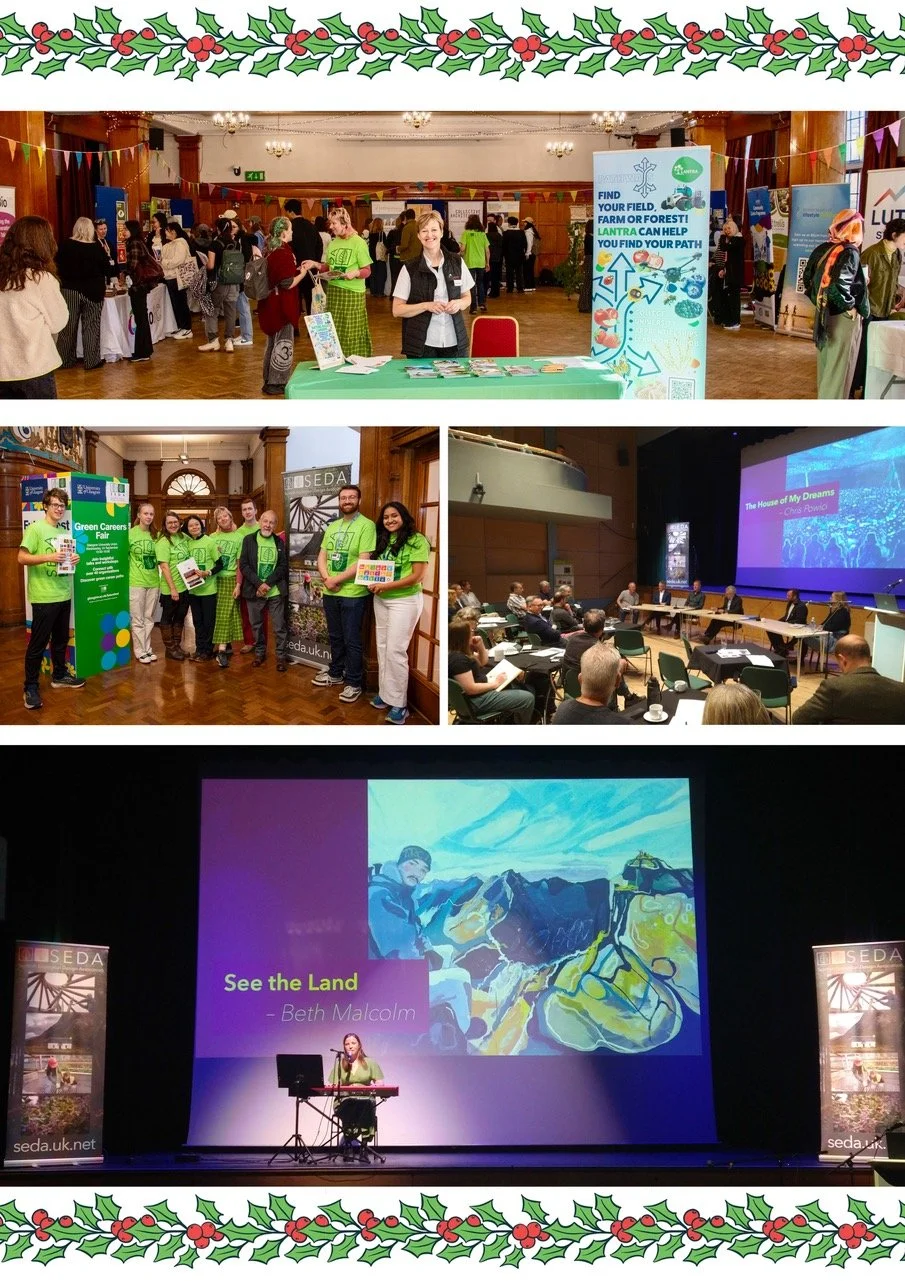
Possibly the highlight of the year was the Green Careers Fair held at the University of Glasgow during their careers week on 22nd September. It had an emphasis on land related careers which are not typically represented. Thanks to all SEDA Land contributors who took part. It was such a success, with over 600 students attending, that several universities have since asked if we will do something similar with them in 2026. I received this message from one of the students:
"It has been quite a daunting experience finishing university and deciding what to pursue. I was considering walking away from computer science, then saw the email for the SEDA fair on that morning and thought I’d check it out. It’s really changed my mind and inspired me to put my skills to a good use. So if you ever need confirmation that the work you do has direct and tangible impacts, look no further than me! Thank you!”
2026 will be the fifth anniversary of SEDA Land. I considered running a repeat of the 6 land conversations on the back of which SEDA Land was founded. However after running many events about what we can do differently, more sustainably and cross-sectorally for the past five years I felt we should address the how rather than the what in the next series. Therefore we will be running three events in the autumn looking at local value chains and how these might be set up. More information to follow.
Coincidentally, or possibly reflecting a growing desire to buy more locally – two small community farms have set up within a mile of my home this year – Willow Farm and Bramblewood farm. Both have been set up by complete newcomers to farming – one an ex-Scotland rugby player and the other an ex army major. Interesting transitions and hopefully indicative of a growing trend.
I'm very lucky to have the support of such a diverse group of experts from a range of fields. Many thanks to Lucy Filby and Chris Powici, who have stepped down from the SEDA Land steering group, for their valuable contributions over the past couple of years. I am delighted that Sophie Cooke will be rejoining us and warmly welcome our two new members – Bea Nichol and Adam Forrest. You can learn more about all our steering group members on our website here. Thanks to you all.
We could not operate without ourbackup team. And behind the scenes, Lindsey Stewart Sherrod has replaced Eleanor Fraser and Maisie McDavid to work on the SEDA Land resource pages.
SEDA Land wishes you all a very Merry Christmas and a happy New Year.