November Greendrinks, Edinburgh
SEDA for an informal evening chatting to like-minded people who care about ecological design and climate mitigation.
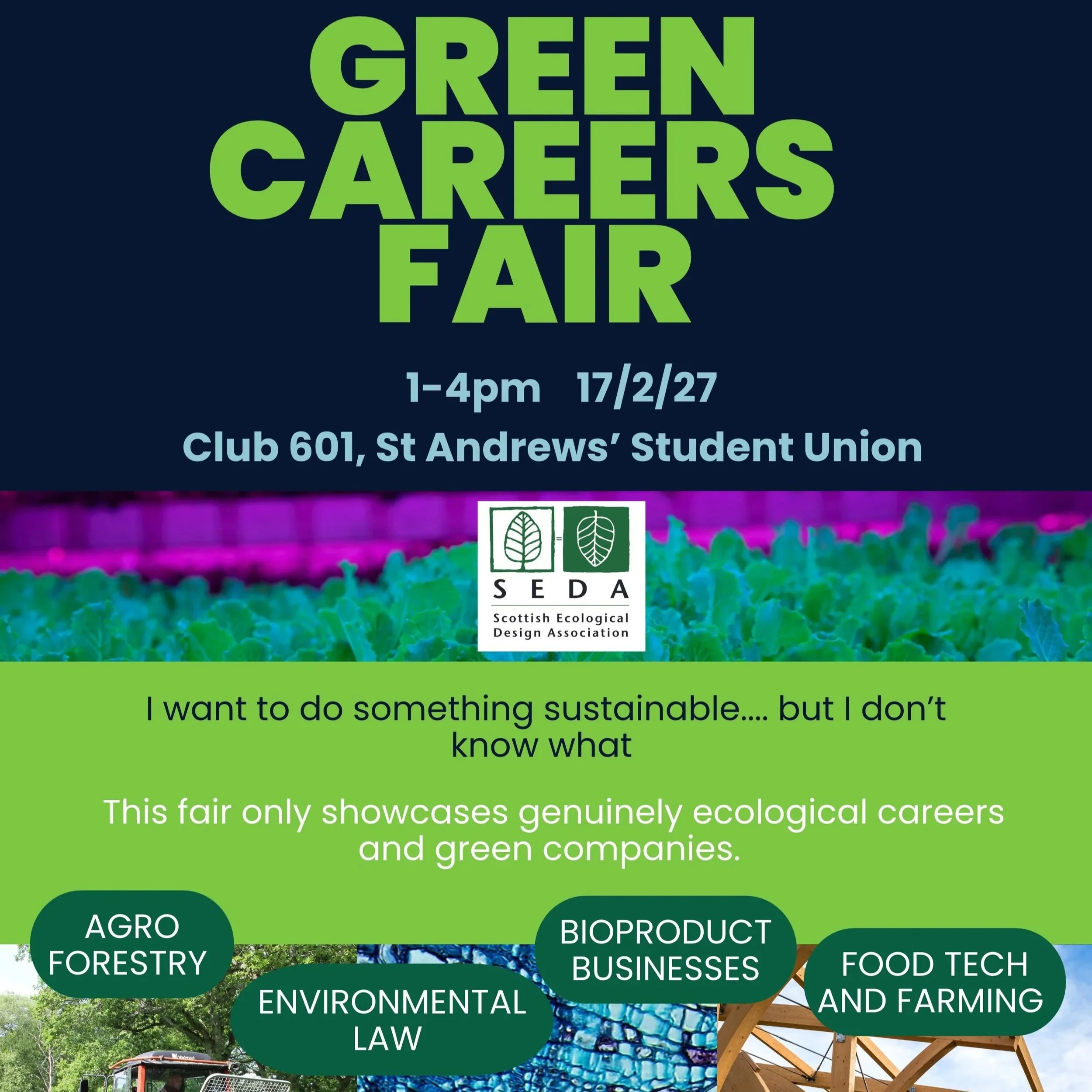
SEDA’s green careers fair will run from 1 pm to 4 pm on Wednesday 17th February 2027.
The fair will showcase small and medium sized enterprises, as well as large corporations, in order to highlight the full range of green jobs available. Only people or companies run along ecological principles have been invited.
It is SEDA’s wide network of connections in ecological and sustainable sectors that will make this event different from normal careers fairs. We have invited many people not normally represented such as community renewable energy practitioners, hemp insulation manufacturers and green health prescribers.
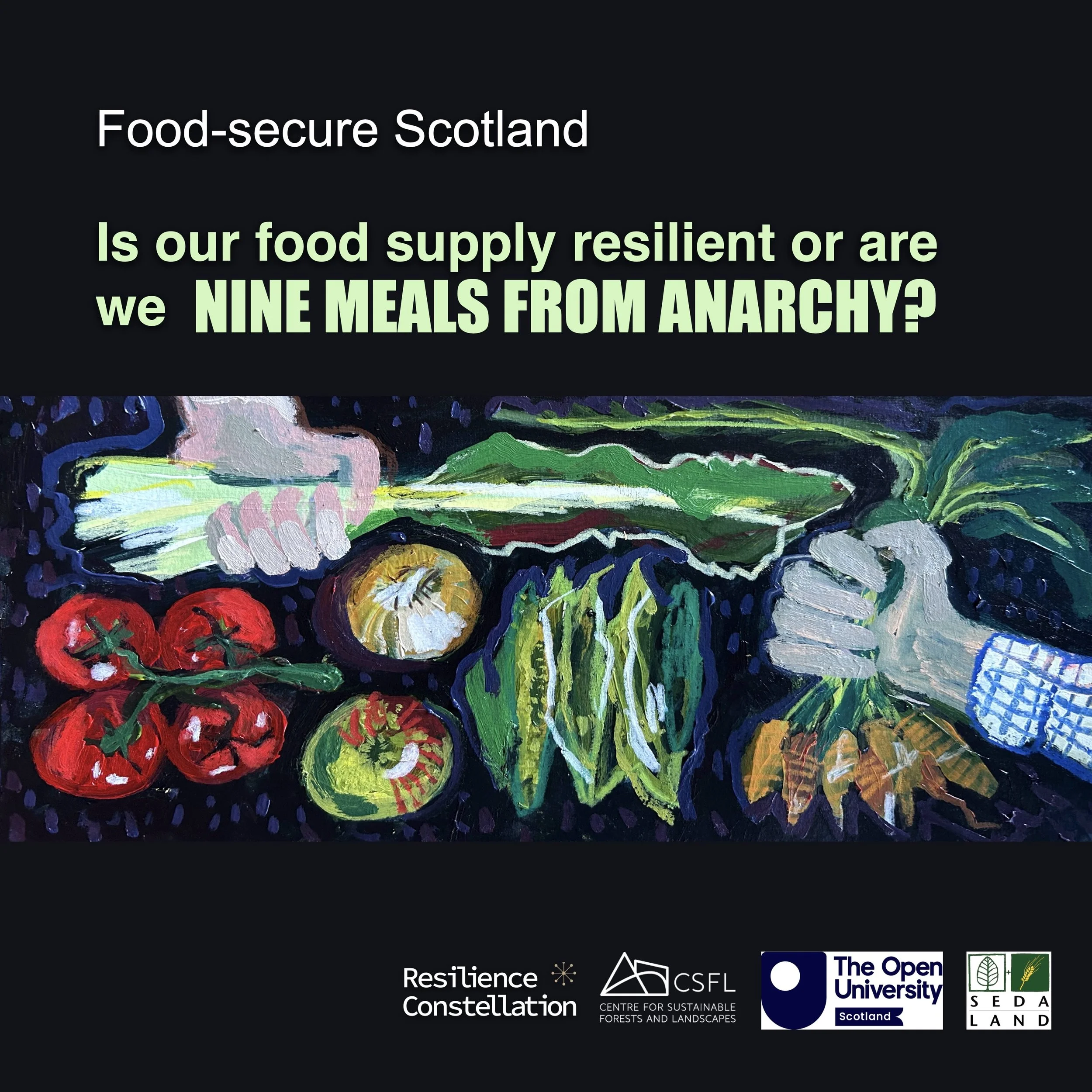
Co-organised by Resilience Constellation & Centre for Sustainable Forests and Landscapes (CSFL)
Is our food supply resilient or could we be nine meals from anarchy?
Is Scotland’s food system resilient or facing a crisis?
Recent extreme weather, coupled with the prospects of El Niño, climate change and trade disruptions have highlighted the issue of food security as a matter of urgency. Commentators and politicians have proposed a range of interventions, including stockpiling, a drive towards self-sufficiency and changes to agricultural support. But what is the nature of the problem in Scotland, what interventions are needed, what will work, and who should be involved?
This discussion will address:
- The nature and urgency of the problem
- Potential solutions and their limitations
- The roles for government, communities, business and organisations
Join SEDA for an informal evening chatting to like-minded people who care about ecological design and climate mitigation.
You are invited to a post Festival / Conference meeting of the regular night in Edinburgh, where you can meet like-minded people interested in eco design and climate mitigation.
Landscape-Scale Governance is the third in the CHAMPIONING THE LOCAL series of SEDA Land Conversations.
Online – free admission
This conversation will explore when it may be appropriate to scale up the model to regional or national level. Regional Land Use Partnerships (RLUPs) and bioregions are models bordered by natural geographic and landscape boundaries such as mountain ridges and watersheds. Both adopt a natural capital approach to understanding their regional landscapes. This addresses issues in a cross-sectoral way, using a systems approach, rather than simplifying the issues into sectoral silos. This is a challenging ambition, since it means grappling with the complexity, uncertainty and trade-offs inherent in large scale, closely coupled, socio-ecological systems, but policy and land use decisions (such as natural flood protection measures) are often best made at such a scale.
Join SEDA in person or online for the premier screening of 2045: The Big Conversation: The Movie, followed by a discussion.
Two years ago the Scottish Government funded SEDA to bring together people from across the built environment sector to discuss the challenge of climate change.
The biggest threat to Scotland’s future is climate change. Scots are already losing their jobs, homes and lives. Nature is pushed towards extinction. Greenhouse gasses are still increasing. 40% of Scotland’s emissions come from the built environment. And we don’t have a plan to stop them.
Friday 18th to Sunday 20th of September
Falkland Estate, Fife
Councils Need to Buy Better is the second in the CHAMPIONING THE LOCAL series of SEDA Land Conversations.
Online – free admission
This Conversation will highlight the role that local authorities of the critical role they can play in enhancing local economies.
The Scottish Government is committed to integrating social value and wellbeing into public procurement through not only the Procurement Reform (Scotland) legislation, but also the Scottish National Performance Framework strategy.
In April 2023 the Scottish Government published the first Public Procurement Strategy for Scotland. Local authority procurement – on the long-term contractual basis – can give communities the much needed confidence to invest and kickstart new enterprises.
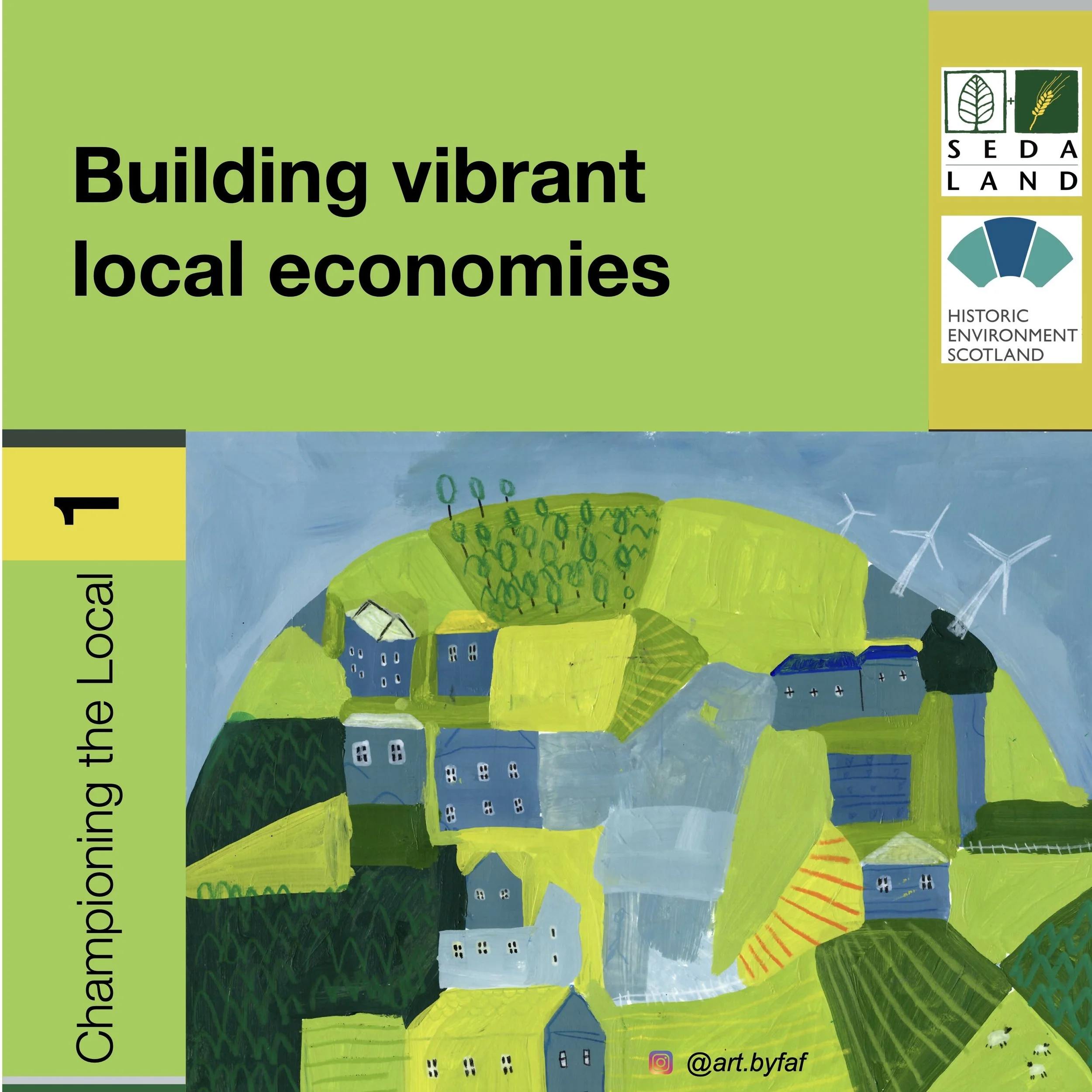
Building vibrant local economies is the first in the CHAMPIONING THE LOCAL series of SEDA Land Conversations.
Online – free admission
This Conversation is aimed at helping community groups realise their ambitions
We will explore alternative business models, including co-operatives, social enterprises and employee-owned businesses, and how they can make LVC’s possible, as well as the best scale at which such issues can be addressed – local, regional or national.
Join SEDA during the visit to the regenerated eco home and explore use of cast hemp, reused steel and open loop heat pump.
You are invited to a new regular night in Edinburgh, where you can meet like-minded people interested in eco design and climate mitigation.
Blue Sky Architecture began as a design/build firm during the 1970s on Hornby Island, one of the archipelago to the west of British Columbia. The 1980s brought significant international recognition. By the early 1990s their practice was well established in West Vancouver, where it thrives today.
2.5 hours of talks and screen presentations followed by 1 hours tours round the Briggait guided by the architects of the various phases
Consider how to build on Jim’s legacy including visiting and holding the event in one of his earliest projects
The RIAS Bookshop and SEDA invite you to join Professor Susan Roaf for a discussion of her research around adaptive thermal comfort
Join us on Thursday 30th April when Professor Susan Roaf will be discussing the research behind her latest book Adaptive Thermal Comfort: At the Extremes with architect Gloria Lo.
Doors open: 18:00
Talk begins: 18:30
Venue: RIAS Bookshop, 15 Rutland Square, Edinburgh, EH1 2BE
Tickets: £3 (FREE for RIAS and SEDA Members)
Forest schools and outdoor nurseries are becoming more prevalent in Scotland and their benefits are well-known, so why are they not being systematically rolled out or integrated into the Scottish education system?
How can natural building methods respond to real client needs while delivering measurable health benefits?
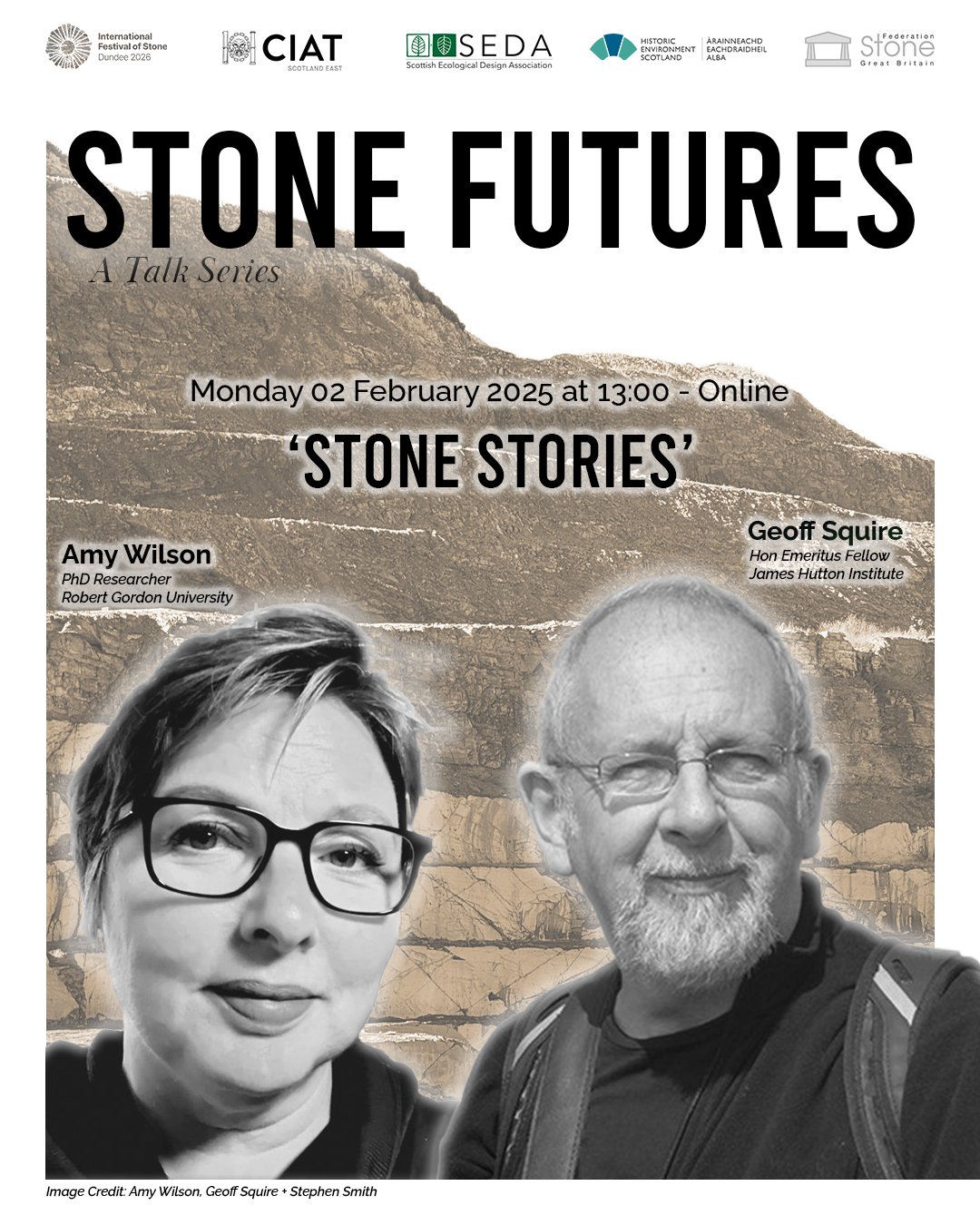
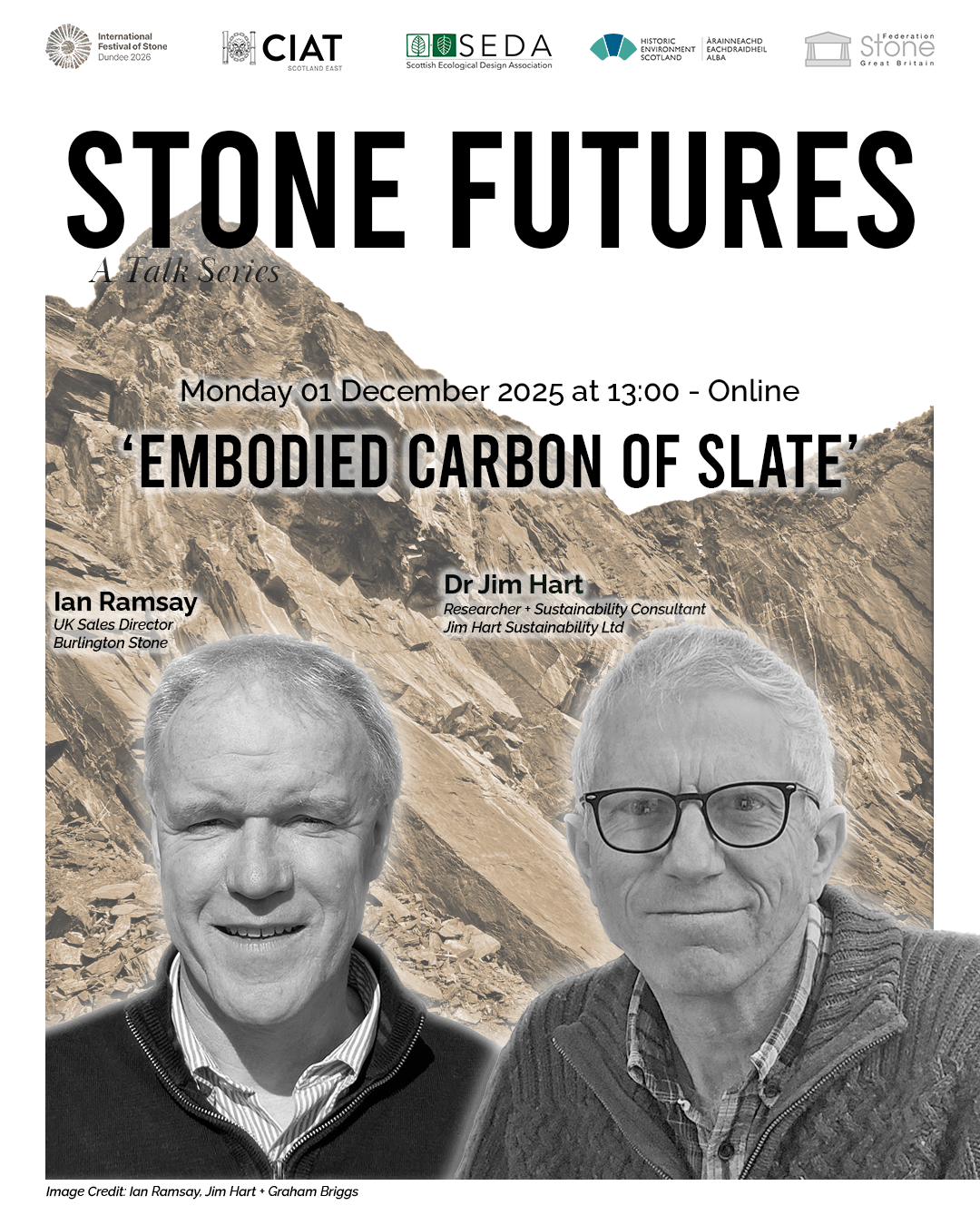
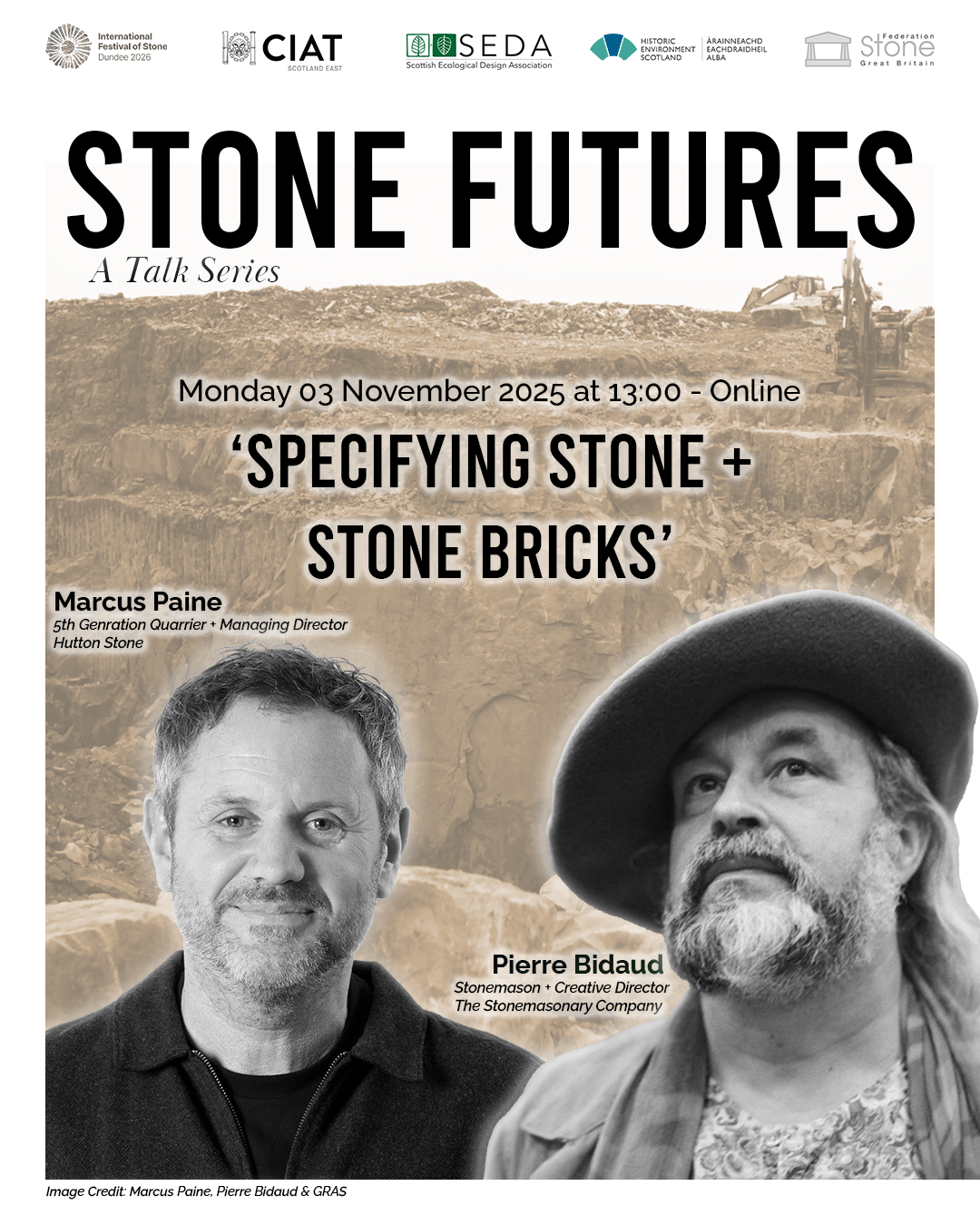
A new lunchtime CPD seminar series dedicated to one of the most enduring yet ever evolving materials in our built environment: Stone
Overview
A documentary on grassroots resistance to extractivism through Italy, Serbia, and Sápmi. The event is hybrid.
Food and refreshments available for a donation
Get ready to dive deep into the world of environmental standards in our upcoming webinar
The Webinar will provide an overview of Environmental Standards Scotland, including our core functions and statutory powers. We’ll share real case examples from completed investigations, explain how individuals can raise concerns with us, and conclude with an interactive Q&A session.
A new lunchtime CPD seminar series dedicated to one of the most enduring yet ever evolving materials in our built environment: Stone
Join us for the discussion about the use and potential of biobased materials and offsite production in housebuilding.
SEDA's annual informal night showing members work.
Members are being invited to show off your work, research and interests to the others, catch up over some food and drinks.
A new lunchtime CPD seminar series dedicated to one of the most enduring yet ever evolving materials in our built environment: Stone
Across the autumn and winter, Scotland East Region, Scottish Ecological Design Association (SEDA) and Historic Environment Scotland (HES) are excited to launch a new lunchtime CPD seminar series dedicated to one of the most enduring yet ever evolving materials in our built environment: Stone
This conference will be an exploration of the wider issue of “Sufficiency.” As always, it will be full of thoughtful and insightful discussions!
More information can be found on the Conference webpage https://seda.scot/seda-conference-2025
SEDA’s green careers fair will run from 10am to 4pm on Wednesday 24th September 2025, during
the week of the University of Glasgow’s Careers and Internship.
The fair will showcase small and medium sized enterprises, as well as large corporations, in order
to highlight the full range of green jobs available. Only people or companies run along ecological
principles have been invited.
It is SEDA’s wide network of connections in ecological and sustainable sectors that will make this
event different from normal careers fairs. We have invited many people not normally represented
such as community renewable energy practitioners, hemp insulation manufacturers and green
health prescribers.
Only students who have signed up in advance on Eventbrite will be allowed entry.
Good ventilation is essential for healthy, comfortable, and resilient buildings—but as mechanical systems become more dominant, it's critical to ask: are we designing for long-term wellbeing, or creating new dependencies?
This event explores why ventilation matters—not just for compliance or technical performance, but for occupant health, comfort, and the psychological benefits of environmental control. As buildings increasingly rely on mechanical systems, understanding building physics, material choices, and passive design strategies becomes more important than ever.
Through case studies and discussion, we’ll demonstrate how to design for indoor air quality while considering flexibility as well as ethics. We’ll look at how passive and natural ventilation, and low-impact construction materials can support both regulatory standards and 'passive survivability'—the ability for buildings to remain safe and comfortable during power outages or emergencies.
The session will highlight practical examples from engineering and architectural practice, with a focus on avoiding 'eco-bling' and prioritising real, long-term benefits for occupants. Participants are invited to bring project-specific questions for open discussion.
With Jonathan Watts, the Global environmental correspondent for The Guardian and author of “The Many Lives of James Lovelock: Science, Secrets and Gaia Theory”
Saturday 9 th August 2025
12noon – 2pm
EVENT INFORMATION
James Lovelock is best known for his association with the Gaia Hypothesis - which proposed that living organisms interact with their surroundings to create a self-regulating system and thereby maintain conditions suitable for life on Earth. This event will look at his life and legacy and whether Lovelock’s pioneering environmental work offers us guidance now.
As with the previous eco-pioneers investigated in this series (Rachel Carson, Barry Commoner, Ian McHarg, Sherry Arnstein and Fritz Schumacher) Lovelock influenced a generation. Lovelock perhaps uniquely also spawned a vast array of Gaia related businesses from coffee shops, to research institutes and even big pharma. Amongst the earliest were Gaia Architects in Scotland and Norway.
The Eco Max series is dedicated to Howard Liddell who was the founder and principal of Gaia Architects from 1990 until his death at the age of 67 in 2013. Howard book Eco-minimalism: the Antidote to Eco-Bling (2008, 2013 was always intended to be the first half of the story. He was aiming to write a further book Eco-Max based on the legacy of his eco-heroes. His widow, Sandy Liddell Halliday, founded and sponsors this series of talks, in collaboration with the Scottish Ecological Design Association, of which Howard was a founder member.
Lovelock remains a controversial figure, a uniquely gifted independent scientist, inventor and thinker who, amongst other things, invented the electron capture detector that allowed him to detect the widespread presence of chlorofluorocarbons (CFCs) in the atmosphere. He infuriated many of his Gaia-fan followers by his abiding techno-optimistic approach, including his support for nuclear power and space travel.
Jon Watts, the global environmental correspondent for the Guardian, was given unique access to author Lovelock’s official biography. He will present an overview and there will be a structured interview ollowed by an open Q& A session and a book signing.
Please book early so that we can get a clear idea of numbers.

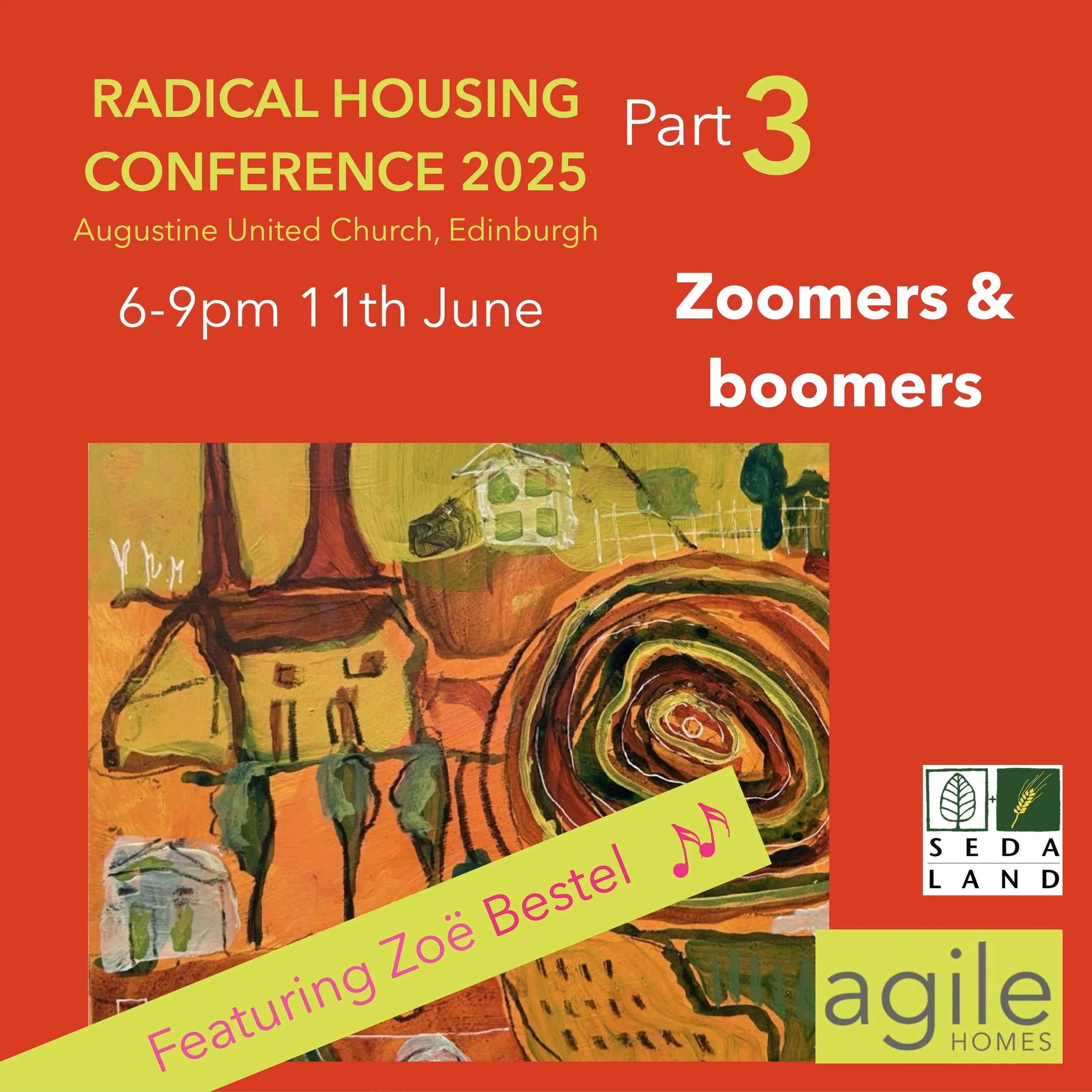
Join us for an exploration of what it takes to create thriving intergenerational communities at the Radical Housing Conference Scotland Part 3: The Zoomers & Boomers Soirée!
Part 3 of the Radical Housing Conference Scotland 2025 will be an informal soirée with food and drink, poetry and music, being held at the Augustine United Church, on George IV Bridge, Edinburgh, on 11 June, as part of the Architecture Fringe.
Learn from experts in the field and connect with like-minded individuals. Whether you're a housing advocate, community representative or policymaker – or simply interested in learning more about the pros and cons of intergenerational living, this is the event for you.
We will discuss the benefits of intergenerational living – how it strengthens the broader community and helps tackle loneliness. We will also look at the obstacles to more intergenerational living. Why do we have a culture that doesn't promote this and what can be done to change the culture?
“I believe that integration across traditional silos - such as age groups - must be a vital focus for a country burdened by an obsession with the ‘nuclear family ’” – Savannah Fishel, Churchill Fellow, and speaker at the conference.
The evening will be filled with insightful discussions and networking opportunities – a must-attend for anyone passionate about intergenerational housing in Scotland.